What Vacuum Level Is Required for Transformer Oil Purification?

Oil Purification & Vacuum Technology Expert
Table of Contents
Vacuum level is one of the most important operating parameters in transformer oil purification, particularly when the treatment objective includes dissolved moisture and dissolved gas removal. However, selecting a vacuum level is not simply a matter of choosing the lowest pressure a purifier can achieve. A transformer oil purifier may have an impressive ultimate vacuum specification while operating at a different pressure when processing oil under a real vapor load. Oil temperature, moisture content, flow rate, vacuum chamber design, condenser capacity, and pumping speed all influence the pressure that can actually be maintained during treatment.
For this reason, engineers should distinguish between ultimate vacuum and working vacuum. The more useful question is not “How deep a vacuum can the machine reach?” but rather “What working vacuum can the purifier maintain under the required oil-processing conditions?” This distinction is particularly important for high-voltage transformer maintenance, where moisture and dissolved gases must be reduced without unnecessarily increasing processing time or thermal stress on the oil.
Vacuum Pressure Terminology: What Does “Vacuum Level” Actually Mean?
Before selecting a transformer oil purifier, it is important to understand how vacuum performance is specified. Vacuum is normally discussed in terms of absolute pressure, while some equipment documentation or gauges may describe vacuum using relative pressure or vacuum degree.
Absolute pressure is measured from a theoretical perfect vacuum. Therefore, a lower absolute pressure represents a deeper vacuum. For example, 100 Pa represents a deeper vacuum than 500 Pa, while 0.1 mbar represents a deeper vacuum than 1 mbar. For engineering calculations, the most commonly encountered conversions are:
| Absolute Pressure | Equivalent |
| 1 mbar | 100 Pa |
| 0.5 mbar | 50 Pa |
| 0.1 mbar | 10 Pa |
| 0.01 mbar | 1 Pa |
The distinction between ultimate vacuum and working vacuum is even more important. Ultimate vacuum describes the lowest pressure a vacuum system can theoretically reach under specified conditions, usually with little or no process load. Working vacuum describes the pressure that can actually be maintained while transformer oil is being heated, circulated, separated, and continuously exposed to the vacuum environment.
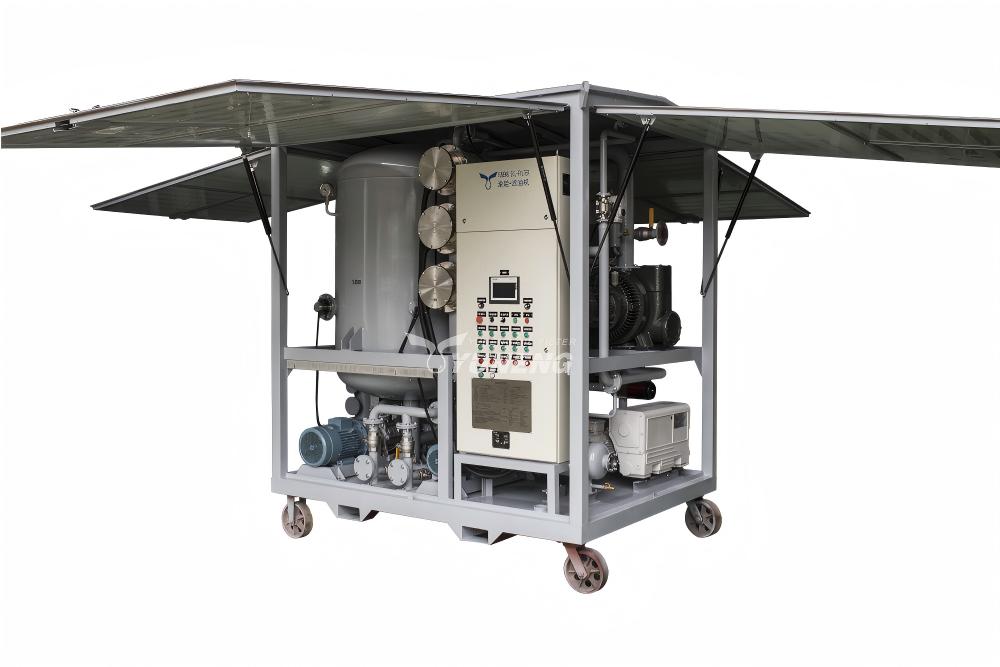
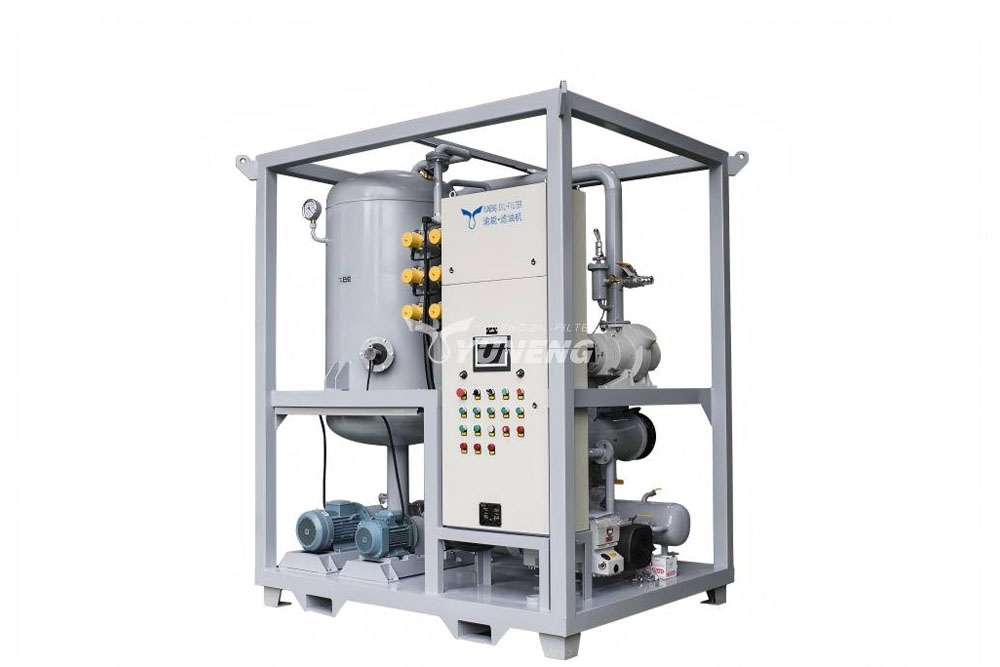
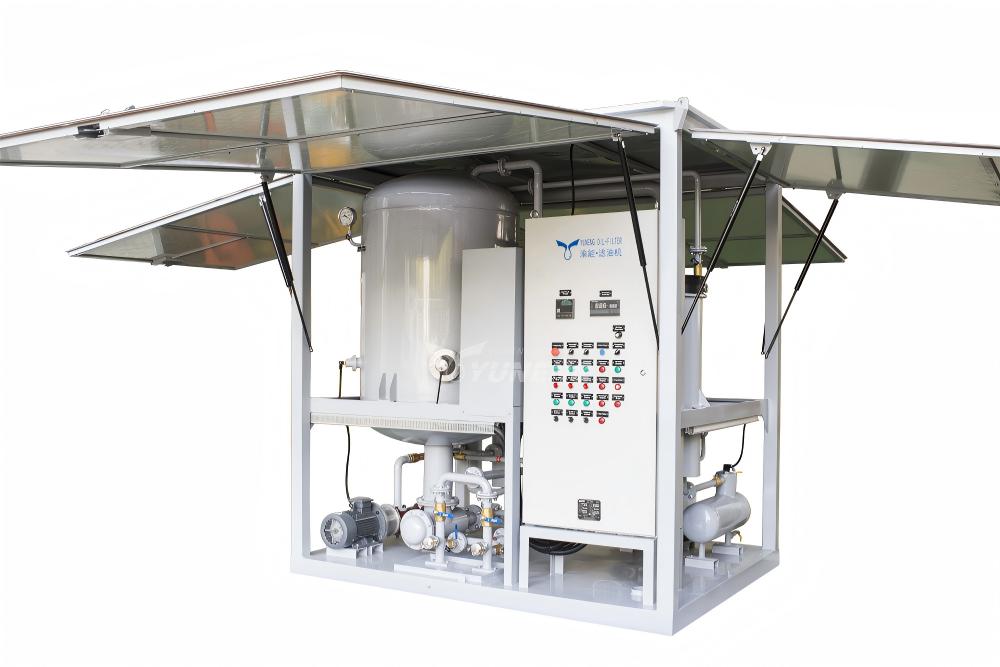
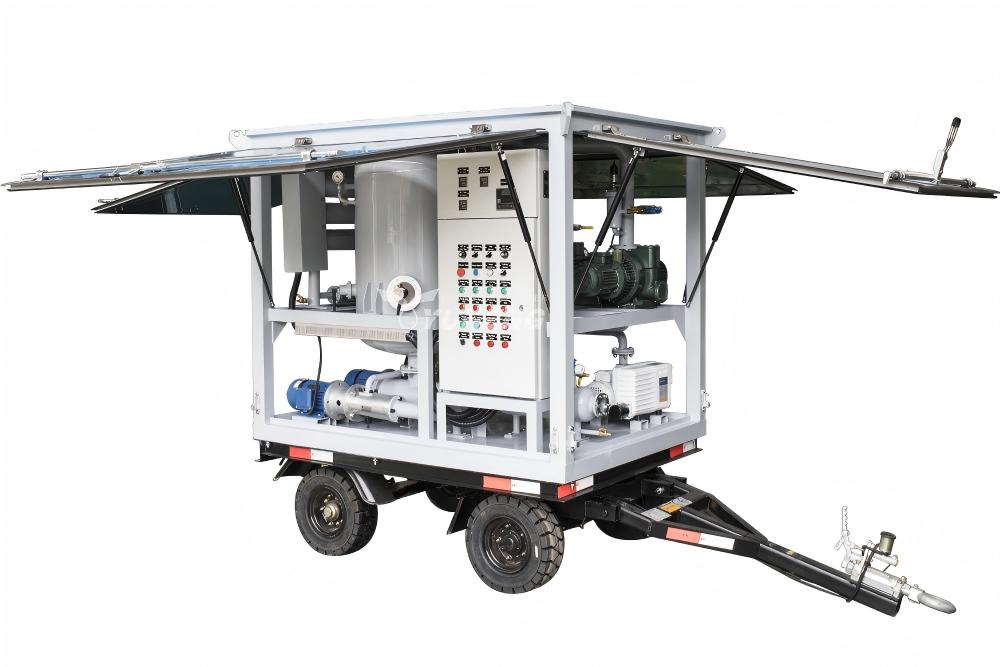
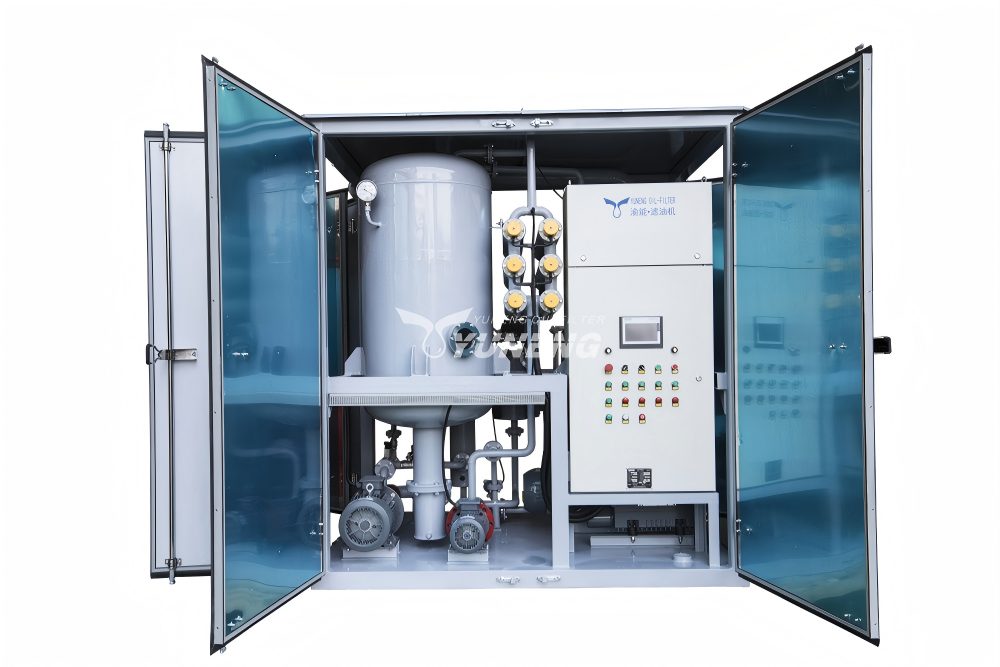
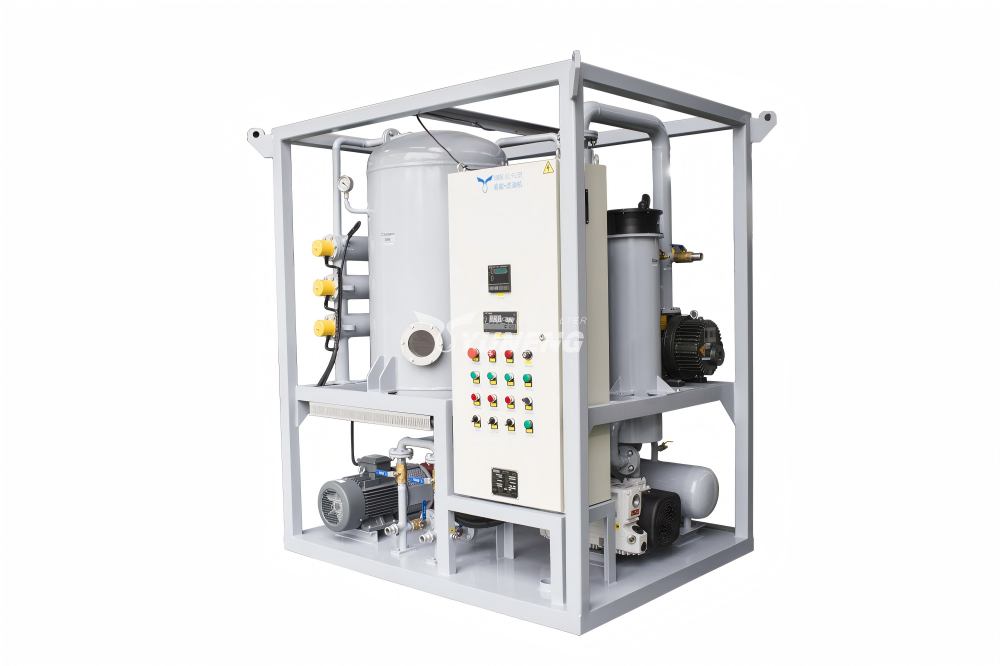
For transformer oil purification, working vacuum is therefore the more meaningful performance parameter. YUNENG’s double-stage systems, for example, specify a working vacuum of ≤80 Pa, while its broader product literature distinguishes this operating parameter from the much deeper ultimate vacuum capability.
Why the Required Vacuum Level Depends on the Treatment Objective
There is no single vacuum level that is correct for every transformer oil purification application. The required operating pressure depends first on what the treatment needs to accomplish. When the primary problem is free water or relatively large quantities of readily separable moisture, a vacuum system does not necessarily need to operate at its deepest possible pressure. Proper heating, sufficient separation area, and appropriate residence time can already provide effective moisture removal.
Dissolved moisture presents a more demanding condition. Water that is dissolved within the oil does not behave in exactly the same way as free water. Its removal depends on the relationship between oil temperature, absolute pressure, mass transfer, exposed surface area, and residence time. A deeper vacuum can improve the driving force for moisture release, but vacuum alone does not guarantee rapid dehydration.
The same principle applies to dissolved gases. Lower pressure encourages dissolved gases to leave the liquid phase, but degassing performance also depends on how effectively the purifier creates gas-liquid contact and removes the liberated gas from the separation chamber. This is why a vacuum oil purifier should be viewed as an integrated pressure–temperature–mass-transfer system, rather than simply a machine containing a powerful vacuum pump.
Transformer evacuation and oil purification should also be distinguished. Evacuating a transformer tank before oil filling is a different operation from maintaining working vacuum inside an oil purification chamber. Although both processes use vacuum technology, their equipment configurations, pressure requirements, and engineering objectives are not necessarily identical.
What Vacuum Level Is Typically Used for Transformer Oil Purification?
The practical vacuum level depends on the purifier design and treatment objective. YUNENG’s existing technical information illustrates this range: one of its articles describes high-vacuum systems operating below 1 mbar, while its double-stage ZJA systems specify a working vacuum of ≤80 Pa. Its newer purification guide describes primary vacuum systems around 1 mbar and Roots-assisted systems capable of reaching below 0.1 mbar for demanding applications.
These figures should not be interpreted as universal limits for all transformer oil purifiers. A specification such as “≤80 Pa” tells you about the design capability of a particular machine; it does not mean that every transformer oil treatment process must operate at exactly 80 Pa. A more useful engineering interpretation is:
| Treatment Condition | Vacuum Requirement |
| Routine moisture conditioning | Moderate to deep vacuum, depending on oil condition |
| Dissolved moisture removal | Deeper working vacuum with controlled heating |
| Dissolved gas removal | Deep vacuum combined with effective gas-liquid separation |
| High-voltage transformer oil treatment | High-vacuum system where stringent oil quality is required |
| Severe moisture or gas contamination | Deep vacuum with sufficient pumping capacity and vapor handling |
The correct specification should therefore identify working vacuum under rated processing conditions, rather than relying exclusively on the ultimate vacuum value. For demanding applications, YUNENG’s double-stage systems combine a primary vacuum pump with a Roots booster configuration. Its published ZJA specifications list a working vacuum of ≤80 Pa and operating temperatures of 45–65°C for its range of double-stage transformer oil filtration machines.
Why Ultimate Vacuum Does Not Equal Actual Purification Vacuum
This is one of the most important concepts when evaluating transformer oil purification equipment. Imagine two machines that can both achieve a very deep vacuum during an unloaded test. Once transformer oil enters the system, however, the conditions change immediately. Moisture begins to evaporate, gases are released, oil is continuously circulated, and the condenser and vacuum pump must handle the resulting vapor load.
The actual chamber pressure is determined by the balance between the amount of gas and vapor being generated and the system’s ability to remove it.
1. Water Vapor Load
Wet transformer oil introduces a substantial vapor load into the vacuum system. As water is released from the oil, the vacuum pump must remove the resulting vapor through the condenser and associated piping.
If the vapor load exceeds the effective capacity of the vacuum system, the working pressure may rise even though the pump has an excellent no-load ultimate vacuum specification. This explains why a machine can reach a very deep vacuum during an empty-chamber test but achieve a less aggressive pressure while treating heavily contaminated oil.
2. Oil Temperature
Oil temperature also changes the vacuum operating conditions. Heating lowers viscosity and facilitates moisture release, but it can simultaneously increase the quantity of vapor entering the vacuum system.
Consequently, vacuum performance should always be evaluated together with the specified oil temperature. YUNENG’s published ZJA operating data, for example, gives a temperature range of 45–65°C alongside its working vacuum specification.
3. Oil Flow Rate
Flow rate has a similar effect. Increasing throughput increases the amount of oil entering the vacuum chamber per unit time. If the oil contains substantial moisture, the vapor load can also increase. This means an oil purifier rated at 6,000 L/h should not be evaluated only by its nominal flow rate. Engineers should also consider whether the machine can maintain its specified working vacuum at the intended throughput.
In practical terms: Higher flow rate + higher moisture load + insufficient pumping capacity = higher actual chamber pressure.
Therefore, rated capacity and vacuum performance must be evaluated together.
Vacuum Level and Oil Temperature Must Be Considered Together
Vacuum and temperature are closely connected during transformer oil dehydration. Reducing absolute pressure lowers the temperature at which water can evaporate. This allows moisture to be released from transformer oil without requiring excessively high bulk oil temperatures.
At the same time, temperature influences viscosity and mass transfer. Properly controlled heating can make it easier for dissolved moisture to migrate from the oil into the vapor phase. The objective is therefore not to maximize either temperature or vacuum independently. It is to establish an appropriate operating window in which:
- the oil is sufficiently fluid;
- moisture can be released efficiently;
- vapor can be continuously removed;
- the vacuum system remains stable; and
- the oil is not exposed to unnecessary thermal stress.
This is one reason professional vacuum oil purifiers use controlled heating rather than simply increasing temperature.
How Vacuum Requirements Change with Oil Condition
The initial condition of transformer oil should be assessed before selecting or operating the purifier. Oil with relatively low moisture and gas content may require less processing intensity than heavily contaminated oil. In contrast, oil containing substantial dissolved moisture or gas requires sufficient vacuum depth, temperature control, residence time, and vapor-handling capacity to achieve the desired final condition.
Oil viscosity and aging can also affect the process. Heavily aged oil may contain oxidation products, sludge, or acidic compounds that cannot simply be removed by increasing vacuum. Vacuum purification is primarily a physical conditioning process. It is highly effective for moisture, dissolved gases, and suspended particulate contamination, but it does not automatically reverse chemical aging.
This leads to an important engineering rule: A deeper vacuum cannot compensate for an unsuitable purification process. If the oil is severely oxidized, increasing vacuum may not solve high acidity or sludge-related problems. The treatment technology must match the type of contamination.
How to Know Whether the Vacuum Level Is Actually Sufficient
A vacuum gauge alone does not prove that transformer oil purification is working correctly.
The first parameter to examine is whether the system can maintain a stable working vacuum while processing oil, rather than simply reaching a low pressure during startup or no-load operation.
The second is the response of the oil itself. If moisture decreases consistently during treatment, the process is moving in the expected direction. If moisture stops falling despite a stable deep vacuum, the problem may lie elsewhere—such as insufficient heating, excessive flow rate, inadequate oil dispersion, insufficient residence time, or moisture re-entry after treatment.
Gas content should be evaluated separately when degassing is an objective. Similarly, BDV can provide useful evidence of improved dielectric condition, but BDV should not be treated as the only proof of adequate vacuum performance. YUNENG’s recent BDV troubleshooting article identifies insufficient vacuum as only one of several possible causes of persistently low BDV.
A more reliable evaluation therefore combines: working vacuum + temperature + flow rate + treatment time + before/after oil test results. This approach gives engineers a process-based assessment rather than relying on a single instrument reading.
Troubleshooting When the Vacuum Is Not Deep Enough or Not Stable
If a purifier cannot reach its target vacuum, the first assumption should not automatically be that the vacuum pump is too small.
Air leakage is one common cause. Flanges, valves, pipe connections, mechanical seals, inspection covers, and other joints should be checked systematically. A second possibility is excessive vapor loading. Heavily wet oil can introduce enough water vapor into the system to raise the working pressure. Condenser performance and drainage should then be examined.
If the vacuum fluctuates significantly, attention should also be given to vacuum valves, pump operation, oil level control, sensors, and process stability.
Another important diagnostic condition occurs when the machine achieves a deep vacuum, but dehydration remains poor. In this case, the vacuum itself may not be the limiting factor. Oil temperature, flow rate, residence time, separation area, or recontamination may be responsible. The following relationship is useful when diagnosing problems:
| Observed Condition | More Likely Engineering Focus |
| Cannot reach target vacuum | Leakage, pump capacity, valve or piping problem |
| Vacuum falls during dehydration | Vapor load, condenser, moisture load |
| Vacuum fluctuates | Pump/control/valve instability |
| Deep vacuum but poor dehydration | Temperature, residence time, flow or mass transfer |
| Deep vacuum but poor degassing | Gas-liquid contact or separator performance |
| Good vacuum at no load but poor under load | Pumping capacity or vapor-handling limitation |
The objective is to determine why the working vacuum is inadequate, rather than simply installing a larger pump.
When Does a Double-Stage Vacuum System Matter?
A double-stage vacuum system becomes valuable when the purification process requires deeper and more stable vacuum performance under a significant process load. YUNENG’s double-stage systems use a primary vacuum pump and a Roots booster configuration. Its published ZJA specifications identify a working vacuum of ≤80 Pa, while the company describes these systems for demanding transformer and power-transmission applications.
The advantage of a two-stage configuration is not simply that it produces a smaller pressure number. Its practical value lies in providing greater pumping capability and maintaining the required vacuum when the system is dealing with moisture and gas released from continuously processed oil. This distinction is important because a vacuum pump’s ultimate pressure and its ability to maintain that pressure under process load are different performance characteristics.
Therefore, double-stage equipment should be considered when the application requires consistent deep vacuum, intensive dehydration, effective degassing, or treatment of oil associated with higher-voltage equipment.
How to Specify Vacuum Requirements When Buying a Transformer Oil Purifier
When comparing transformer oil purification machines, buyers should avoid evaluating vacuum performance from a single number. A useful technical specification should state the ultimate vacuum, working vacuum, vacuum measurement location, pump configuration, pumping speed, rated oil flow, operating temperature, condenser capacity, and expected performance under rated processing conditions.
Among these parameters, working vacuum under load deserves particular attention. For example, a supplier may advertise an extremely low ultimate vacuum while providing little information about the pressure maintained when the machine is processing several thousand liters of wet transformer oil per hour. That specification alone is insufficient for comparing equipment.
A more meaningful procurement question is: What working vacuum can the purifier maintain at its rated oil flow, specified oil temperature, and expected moisture load?
This question connects the vacuum specification to actual field performance. For high-voltage or critical transformer applications, buyers should also request corresponding before-and-after oil quality data, including moisture, breakdown voltage, gas content, and other parameters relevant to the applicable oil-maintenance standard.
A Practical Vacuum-Level Selection Workflow
The correct vacuum specification should start with the required final oil quality, not with the vacuum pump.
First determine the transformer type, oil volume, initial moisture and gas condition, and required treatment time. Next, identify whether the process is intended primarily for moisture removal, degassing, routine conditioning, or more demanding high-voltage transformer maintenance. The required oil quality then determines the treatment intensity. Vacuum level must be considered together with oil temperature, flow rate, chamber design, residence time, and pumping capacity.
The final stage is verification. After selecting the purifier, engineers should confirm that the system maintains the specified working vacuum during actual processing and then compare the treated oil with the initial test results.
The process can therefore be summarized as:
Treatment objective → Initial oil condition → Required final quality → Working vacuum → Temperature and flow → Pumping capacity → Verification by oil testing
This approach is more reliable than choosing a purifier solely because its catalog lists the deepest ultimate vacuum.
FAQs
Q1: What vacuum level is normally used for transformer oil purification?
There is no universal value. The required working vacuum depends on the treatment objective, oil moisture and gas content, temperature, flow rate, vacuum chamber design, and pumping capacity. YUNENG’s high-vacuum equipment includes systems specified at ≤80 Pa working vacuum, while other system configurations use different operating ranges.
Q2: Is lower absolute pressure always better for transformer oil purification?
No. A deeper vacuum can support moisture and dissolved-gas removal, but purification performance depends on the complete operating system. Excessively deep vacuum without appropriate heating, residence time, vapor handling, or pumping capacity does not automatically produce better results.
Q3: What is the difference between ultimate vacuum and working vacuum?
Ultimate vacuum is the lowest pressure a vacuum system can reach under defined low-load conditions. Working vacuum is the pressure maintained during actual oil processing. For equipment selection, working vacuum under rated conditions is generally more useful.
Q4: What vacuum level is needed to remove dissolved water from transformer oil?
Dissolved water generally requires effective vacuum-assisted dehydration combined with controlled heating and sufficient oil exposure to the vacuum environment. The required pressure cannot be determined independently of oil temperature, moisture concentration, flow rate, and separation system design.
Q5: Why can a purifier reach its rated vacuum but still fail to reduce moisture?
Possible causes include inadequate oil temperature, excessive flow rate, high vapor loading, insufficient residence time, poor oil distribution in the vacuum chamber, condenser limitations, or moisture recontamination. A deep vacuum reading by itself does not prove that mass transfer and dehydration are adequate.
Q6: Does a double-stage vacuum purifier always provide better purification?
Not automatically. A double-stage system provides greater vacuum capability and pumping performance for demanding applications, but final purification quality still depends on the complete system design and operating conditions.